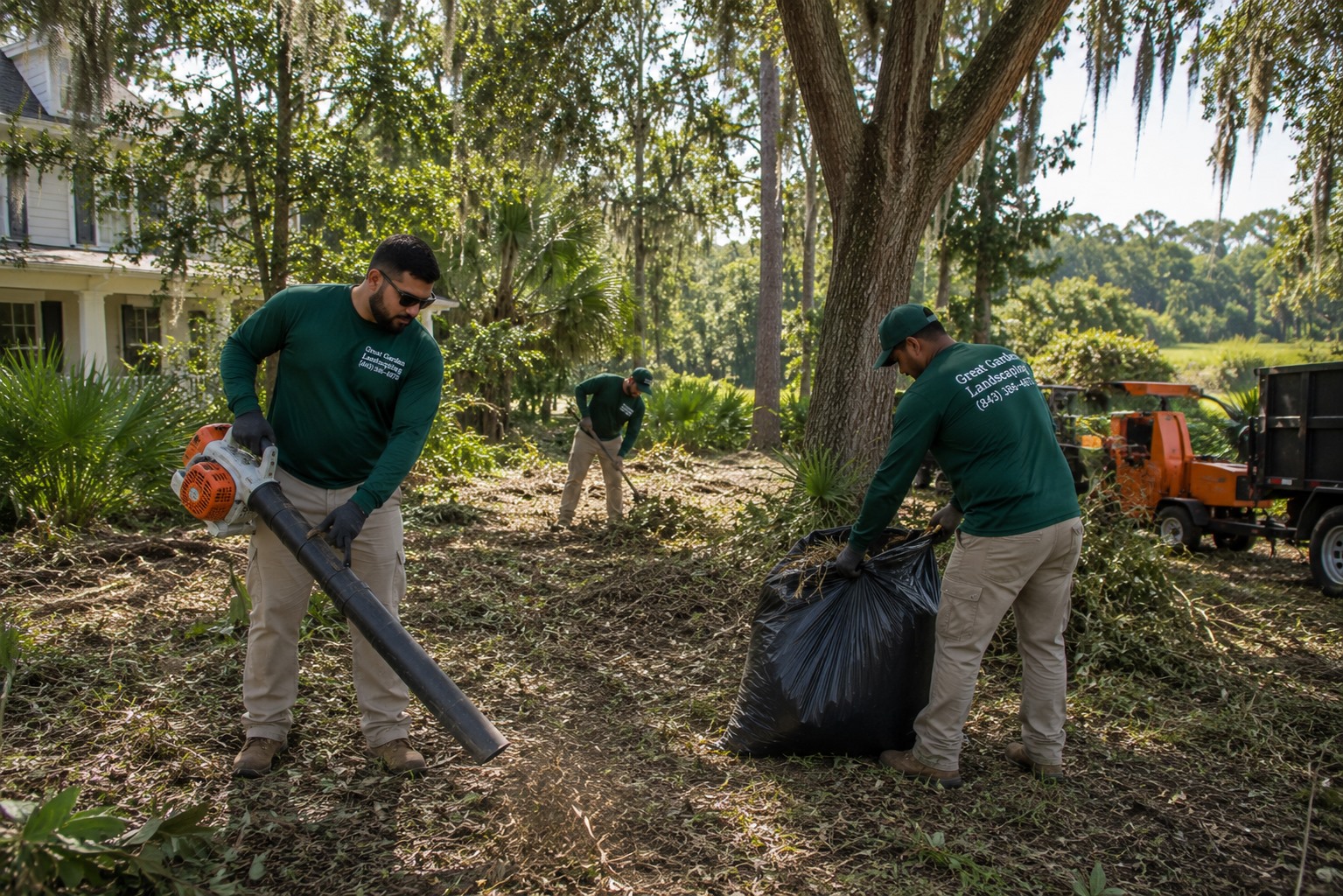
Professional tree removal looks deceptively straightforward from the sidewalk — a crew arrives, chainsaws run, the tree comes down. But the apparent simplicity conceals a sophisticated combination of specialized equipment and rigorous safety protocols that make the difference between a safe, controlled removal and a dangerous incident. Understanding what professional tree removal equipment looks like — and why it matters — helps Johns Island homeowners appreciate what they're getting when they hire a licensed, properly equipped crew.
At Great Garden Landscaping, we maintain professional-grade equipment and train our crews in the safety protocols that protect both our team and your property during every tree removal job in the Johns Island, SC area.
Chainsaws: Not All Are Equal
The chainsaw is the most visible tool in tree removal, and professional saws are fundamentally different from what's available at consumer home improvement stores. Professional-grade chainsaws typically feature anti-vibration systems that reduce long-term operator fatigue, chain brakes that stop the chain in milliseconds if kickback occurs, electronic ignition for reliable cold starts, and higher power-to-weight ratios that make sustained cutting more controllable.
Beyond the saw itself, bar length matters. Professional crews use different bar lengths for different cutting tasks — longer bars for large diameter trunk cuts, shorter bars for precision limb work where a longer bar would be unwieldy and hazardous. Chain type and sharpness also matter significantly: a sharp chain in the right configuration cuts predictably, while a dull chain requires excessive force and increases kickback risk.
Professional crews also maintain their saws meticulously, including chain tension and sharpening, bar groove cleaning, and oiling system function. A saw that fails during a critical cut is a hazard — professional maintenance prevents equipment failure in the field.
Personal Protective Equipment (PPE) — The Non-Negotiables
When evaluating tree removal crews in Johns Island and the greater Charleston area, the safety gear worn by workers is one of the most reliable indicators of professionalism. A crew without proper PPE is cutting corners on safety — which should be a red flag for property owners as well as a liability concern.
Chainsaw-resistant chaps: Required leg protection for all chainsaw operators. These garments contain layers of cut-resistant fibers that clog a chainsaw chain on contact, stopping it before it penetrates to the leg. Without chaps, even experienced operators are one moment of inattention away from a life-altering chainsaw laceration.
Hard hat with integrated face shield and ear protection: A combination head protection unit that guards against falling wood chips, falling limbs, and chainsaw kickback, while protecting hearing from sustained chainsaw noise. Standard helmets alone are insufficient — the face shield is critical when working overhead or under a tree canopy.
Cut-resistant gloves: Protect hands during chainsaw operation, branch handling, and debris clearing where sharp edges are constant.
Steel-toed chainsaw boots: With chainsaw-resistant uppers, these protect against dropped logs, chainsaw contact, and provide the ankle support essential when working on uneven terrain around fallen trees.
High-visibility vests: Important when working near roadways or driveways where vehicles may pass, and for crew communication when multiple workers are on-site.
Climbing Gear for Canopy Work
When a tree must be removed in sections from the top down — the standard technique for trees near structures where felling isn't possible — a climber works within the canopy using a full suite of climbing equipment. Arborist climbing systems use purpose-built saddle harnesses, friction hitches or mechanical ascenders, and rigging hardware engineered for the forces and dynamics of tree work.
Rigging ropes and blocks allow the climber to lower cut sections of wood to the ground in controlled movements rather than dropping them — critical for protecting structures, irrigation systems, and other landscape features below. The combination of climbing skill, rigging knowledge, and equipment selection determines whether a section removal goes smoothly or causes property damage.
A licensed arborist who also holds a climbing certification is the highest standard of professional for complex canopy removals. For Johns Island properties with large live oaks or pines near home structures, this level of expertise is worth seeking specifically.
Ground Support Equipment: Chippers and Trucks
The removal itself is only part of the work — managing the resulting volume of wood and brush is the other. Professional tree removal includes ground equipment for efficient debris handling:
Wood chipper: A truck-mounted or towable chipper processes brush, limbs, and small-diameter wood into chips immediately on-site. This dramatically reduces the volume of material that needs to be hauled, and chips can be used as ground cover or mulch elsewhere. Without a chipper, brush volume management is enormously labor-intensive and time-consuming.
Log truck or trailer: For large-diameter trunk sections that the chipper cannot process, a truck or flatbed trailer hauls material from the property. On residential properties, careful placement and operation of these vehicles matters to avoid lawn and hardscape damage.
Stump grinder: After tree removal, the stump and surface roots that remain can be ground below grade using a stump grinder — a specialized machine with a rotating carbide tooth head that chips wood down to soil level. Stump grinding is the standard method for stump removal, enabling replanting or turf restoration in the area. Great Garden Landscaping includes stump grinding as part of comprehensive tree removal service.
Site Preparation and Property Protection
Before any cutting begins, professional crews prepare the work site to protect your property. Plywood or thick rubber mats protect driveways, sidewalks, and patios from equipment traffic. Drop zones for lowered wood sections are designated and cleared. Nearby plants, irrigation heads, and landscape features are identified and either protected or flagged for crew awareness. A clear communication system between the climber and ground crew is established before work commences.
This preparation phase is invisible to homeowners but represents significant professional judgment — it's where experience most directly prevents property damage during removal operations.
Why Verifying Licensing and Insurance Matters
In South Carolina, verifying that your tree removal contractor carries general liability insurance and workers' compensation coverage is essential. If an uninsured worker is injured on your property during tree removal, your homeowner's liability insurance may be exposed. If an uninsured crew causes property damage to a neighbor's property or vehicle, you may face liability. Licensed, insured contractors transfer these risks appropriately — and their investment in proper equipment and safety protocols is part of what that licensing and insurance reflects.
Great Garden Landscaping is fully licensed and insured for tree removal work throughout the Johns Island, SC area. We're happy to provide proof of coverage before any job begins.
Conclusion: Equipment Reflects Professionalism
The next time you see a tree removal crew at work, look at their PPE, their equipment, and how carefully they've prepared the work site. Those details tell you whether you're watching professionals who take safety seriously — or whether the low bid you got came with hidden risk to your property and the crew's safety.
Professional Tree Removal in Johns Island, SC
Great Garden Landscaping brings proper equipment, full PPE, and licensed professional technique to every tree removal in the Lowcountry. Free estimates.
Frequently Asked Questions
Professional tree removal crews wear chainsaw-resistant chaps, a hard hat with integrated face shield and ear protection, cut-resistant gloves, steel-toed chainsaw boots, and high-visibility vests. Climbers additionally use climbing harnesses, lanyards, and rigging hardware for working at height. This PPE is non-negotiable for safe professional tree work.
A wood chipper allows immediate processing of brush and limbs into chips on-site, dramatically reducing debris volume and hauling labor. For any significant tree removal, a chipper is essentially necessary for efficient debris management. Professional tree removal services include chipper use and debris hauling as standard — you shouldn't have to manage debris yourself.
Yes. Tree removal without proper equipment and training is one of the most hazardous outdoor activities a homeowner can attempt. Chainsaw injuries, falling limbs, and tension spring-back in storm-damaged trees are common causes of serious injury in DIY tree work. Professional crews have both the right equipment and the training to use it safely in unpredictable field conditions.
Great Garden Landscaping serves Johns Island, Charleston, Summerville, and surrounding SC communities. For emergency tree removal, contact us or call (843) 386-4878. Licensed & insured.