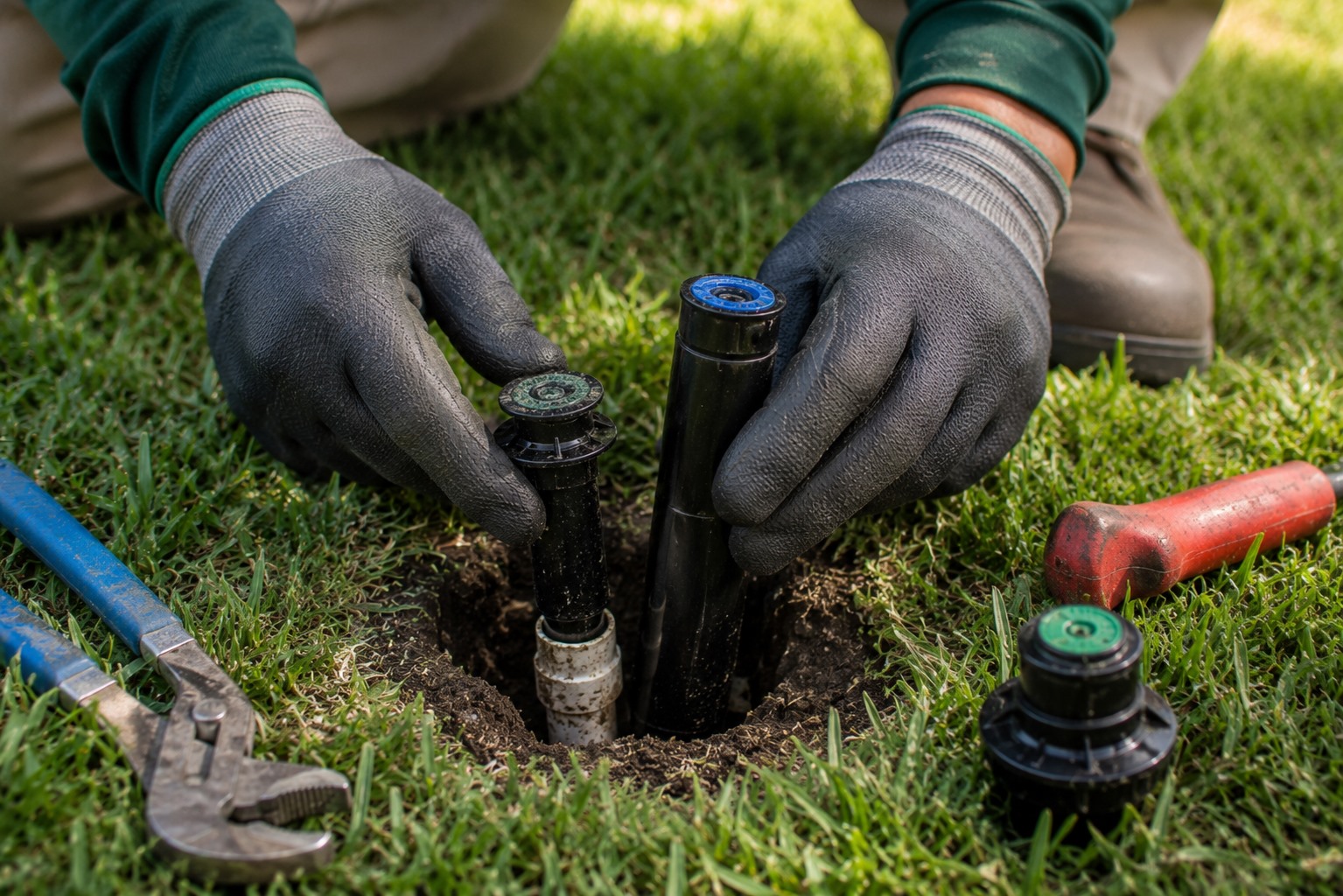
Sprinkler heads are the most visible and most frequently damaged components of any residential irrigation system. Located in lawn and bed areas where they're exposed to lawn mowing equipment, vehicle traffic, foot traffic, and the elements, they take more physical punishment than any other part of the system. In Johns Island, SC and throughout the Charleston area, Great Garden Landscaping repairs and replaces damaged sprinkler heads regularly — and we've learned a great deal about how they fail, what to do about it, and when it makes sense to call a professional versus attempt a DIY repair.
Understanding Sprinkler Head Types in Residential Systems
Before diagnosing and repairing damaged heads, it helps to understand the two primary types used in most Johns Island residential irrigation systems:
Pop-up spray heads are the most common type in residential systems. They have a fixed spray arc and radius, pop up when the zone activates, spray in their preset pattern, and retract when water pressure drops at the end of the cycle. They come in various arc configurations (quarter-circle, half-circle, full-circle, adjustable) and pop-up heights (2, 4, 6, or 12 inch), with nozzles that can be changed to adjust throw distance. Most residential spray heads top out at 15 feet of throw radius.
Rotary heads (rotors) rotate slowly, covering larger areas (15–45 feet throw radius) with a moving stream. They're common on larger turf areas and less common in smaller residential settings. Their moving parts make them somewhat more complex to diagnose and repair than fixed spray heads but still manageable for professional repair.
Knowing which type you have matters when ordering replacement parts — spray head nozzles and rotary nozzles are not interchangeable, and mixing types in a zone creates major coverage and watering efficiency problems.
How Sprinkler Heads Get Damaged in South Carolina
The causes of sprinkler head damage in SC residential settings fall into several recurring categories:
Mower strike: By far the most common cause. A mowing crew member who doesn't know where heads are located, or who uses trimmer equipment too close to head locations, can shear, crack, or break a head in an instant. Once struck, a head may spray a geyser of water, leak continuously at its base, or fail to pop up at all. If you have a lawn mowing service, ensure they know the location of all heads — or that you mark them before mowing if their locations aren't obvious.
Vehicle traffic: Heads installed in locations where vehicles occasionally drive or park — near driveways, along parking areas, or in turf areas accessible to vehicles — are vulnerable to being crushed by tire weight. Even modern pop-up heads rated for some vehicle load can be damaged by repeated traffic. If vehicle access is unavoidable, heads can be relocated away from traffic patterns or protected with decorative rings.
Freeze damage: South Carolina's occasional hard freezes can crack heads that retain water in internal passages. This is less common than in northern states but does occur, particularly on heads in exposed locations. After any freeze event in the Johns Island area, it's worth running each zone briefly and watching for newly misting or leaking heads that may have cracked.
Tree root displacement: In established landscaping with mature root systems, tree roots growing beneath the soil can lift or tilt sprinkler heads over time, pushing them out of plumb and changing their spray angle. Heads that once had correct coverage may gradually be redirected toward the sky or toward adjacent turf, creating coverage gaps.
Age and wear: Internal components — particularly the wiper seal, retraction spring, and nozzle O-ring — wear over time with repeated use. Spray heads in systems that run frequently may need replacement simply due to normal wear after 5–10 years of service.
Diagnosing the Problem: What to Look For
To diagnose a damaged sprinkler head, run the affected zone and observe the head's behavior. Key things to watch:
Geyser or excessive spray at base: Water spraying from the base of a head (around the riser) rather than just from the nozzle indicates the head body is cracked or the riser connection is broken. This requires head replacement and possibly lateral pipe repair if the connection itself is damaged.
Head doesn't pop up: If a head doesn't rise during zone operation, either the head is mechanically stuck (sometimes from debris), the riser is damaged, or the head is broken entirely. If surrounding heads pop up but this one doesn't, focus your diagnostic effort here.
Head doesn't retract: A head that stays extended after the zone shuts off has a failed retraction spring or is physically obstructed. This head will be struck by the next mowing and should be addressed immediately.
Reduced or no coverage pattern: A head that pops up but sprays weakly or at a fraction of its normal radius may have a clogged nozzle. Before replacing the head, try removing and cleaning the nozzle insert — debris is the most common cause of suddenly reduced coverage, and nozzle cleaning is a straightforward DIY task.
Misting fine spray instead of droplets: Indicates excessive system pressure, which atomizes water. This is a zone-wide or system-wide pressure issue, not isolated to the head. A pressure regulator or pressure-compensating nozzles may be the solution.
DIY Sprinkler Head Replacement: When It's Manageable
Replacing a single damaged pop-up spray head with an identical model is one of the more accessible irrigation repairs for motivated homeowners. The basic process:
1. Shut off the irrigation zone and water supply. 2. Dig carefully around the damaged head to expose the riser and lateral connection below. 3. Unscrew the old head from the riser (spray heads thread onto a swing joint or riser nipple). 4. Thread on the new head, hand-tight plus a quarter turn — don't overtighten, as PVC fittings crack under excessive torque. 5. Backfill and tamp around the head, ensuring the head is plumb and at the correct height relative to grade. 6. Run the zone and verify spray pattern and coverage before closing the excavation.
The critical requirement for DIY replacement: the new head must be the same brand and model (or at minimum the same manufacturer with compatible specification), and the nozzle arc and radius should match the original to maintain consistent zone coverage. Installing a head with a different throw radius or arc in a zone disrupts the coverage calibration of the entire zone.
When to Call a Professional for Sprinkler Repair
Some sprinkler repair scenarios are beyond straightforward DIY work and benefit from professional service:
Multiple heads damaged in one zone: If three or more heads need replacement, professional service becomes more efficient and ensures consistent specification throughout the zone.
Damaged riser or lateral pipe connection: If the riser, swing joint, or lateral pipe at the head connection is cracked or broken, the repair extends beyond the head itself and requires proper plumbing repair below grade.
System-wide coverage issues: If coverage problems extend beyond individual heads, a zone pressure issue, valve problem, or pipe problem is the likely cause — requiring professional diagnosis.
Root displacement requiring relocation: Moving a head to a new location requires planning for coverage continuity, cutting into lateral piping, and installing new fittings — professional work.
Great Garden Landscaping handles all types of irrigation repair in Johns Island and the greater Lowcountry — from single head replacements to full zone replanning. Call (843) 386-4878 for a free assessment.
Preventing Future Sprinkler Head Damage
The best approach to sprinkler head maintenance is prevention. Map and mark all head locations for your lawn mowing crew. If mowing-related damage is recurring, consider installing head protectors — ring guards available at irrigation supply stores — around the most vulnerable heads. Address any areas where vehicle access crosses head locations by installing bollards or moving heads during a planned maintenance visit.
Annual professional inspection, ideally each spring before peak summer demand, identifies heads with early wear or minor damage before they fail completely — a much less disruptive and less expensive path than emergency repair during a summer drought.
Conclusion: Well-Maintained Heads Mean Efficient Irrigation
Sprinkler heads are the delivery end of your entire irrigation investment. Damaged or poorly performing heads waste water, create dry patches, and defeat the purpose of the system. Keeping them in good working order — through prompt repair of damage and annual professional inspection — ensures your irrigation system delivers the consistent, efficient coverage your Johns Island landscape depends on.
Irrigation System Repair in Johns Island, SC
Damaged sprinkler heads? Great Garden Landscaping repairs and replaces irrigation components throughout the Lowcountry. Free estimates — licensed & insured.
Frequently Asked Questions
Signs a head needs replacement: it doesn't retract after watering, is visibly cracked, water pools immediately around it during operation, it sprays at significantly reduced or excessive pressure, or the spray pattern is missing or wrong. Clogged nozzles can sometimes be cleaned and reinstalled — but cracked or mechanically failed heads should be replaced.
Replacing a single pop-up head with the exact same model is a manageable DIY task — dig down to the head, unthread the old one, thread on the replacement. However, if you're changing models, adjusting arc or radius, or if the riser or lateral pipe is damaged, professional service ensures correct system performance without disrupting zone calibration.
The most common causes are lawn mower strike (by far most frequent), vehicle or foot traffic over head locations, freeze-thaw cracking during winter cold snaps, tree root displacement that tilts heads out of position, and age-related mechanical failure. Mower damage is highly preventable by marking head locations clearly for any lawn care crew.
Costs vary based on head type, number of heads, and whether there's associated pipe damage. Great Garden Landscaping provides free estimates for irrigation repair in Johns Island and the Lowcountry — call (843) 386-4878 or use our contact form to schedule a no-obligation assessment of your system.
Great Garden Landscaping serves Johns Island, Charleston, Summerville, and surrounding SC communities. For professional irrigation system repair, contact us or call (843) 386-4878. Licensed & insured.